
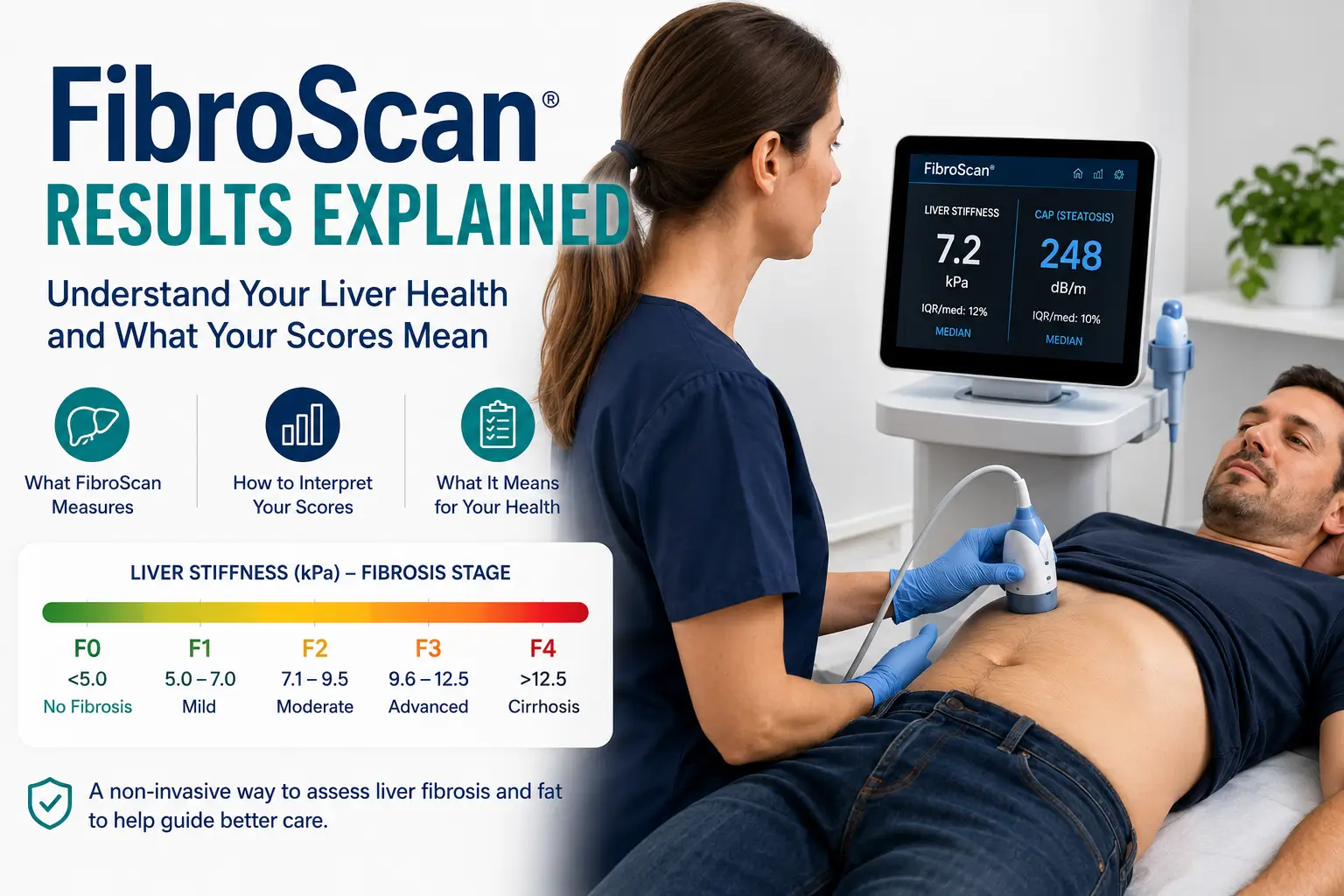
Just had a FibroScan and trying to make sense of the numbers on your report? You are not alone. The scan itself is quick and painless, but the results can look like a string of unfamiliar numbers and acronyms – kPa, CAP, F2, S1 and it is rarely obvious what they actually mean for your health.
This guide explains exactly what your FibroScan results mean, written by a consultant hepatologist who interprets these scans every week. We will cover both numbers on your report: the kPa score (which measures liver stiffness and fibrosis) and the CAP score (which measures liver fat). You will also learn what each result means clinically and when a result genuinely needs further investigation.
If you have not yet had a scan and you are researching your options, you can book a private FibroScan in London performed and interpreted on the day by one of our consultant hepatologists so you understand exactly what your results mean and what comes next.
The kPa score short for kilopascal measures the stiffness of your liver tissue. A healthy liver is soft and elastic. When the liver is damaged over time, scar tissue forms, and the liver becomes stiffer. The FibroScan probe sends a small mechanical pulse through your liver and measures how fast it travels stiffer tissue is associated with a higher kPa value.
This stiffness measurement corresponds to a clinical fibrosis stage from F0 (no scarring) to F4 (cirrhosis). Knowing your stage matters because it determines whether you need lifestyle changes, monitoring, specialist care, or urgent treatment.
You may see “normal” or “reference” ranges for FibroScan scores online, but these are not right for everyone. Your hepatologist will interpret your kPa score depending on the underlying cause fatty liver disease, viral hepatitis, alcohol-related liver disease, and autoimmune conditions each have specific thresholds. This is one of the reasons expert interpretation matters more than an isolated result.
CAP – Controlled Attenuation Parameter measures how much fat is inside your liver cells. It is reported in decibels per metre (dB/m). The probe uses ultrasound to assess how much the signal is attenuated (weakened) by fatty deposits in the liver. More fat means more attenuation, and a higher CAP score.
Fatty liver disease now most commonly called MASLD (metabolic dysfunction-associated steatotic liver disease, previously NAFLD) is the most common liver condition in the UK. CAP scores help diagnose and stage it without the need for a biopsy.
| CAP Score (dB/m) | Steatosis Grade | What It Means |
| Below 238 | S0 | No significant fat (less than 5% of liver cells). |
| 238 – 259 | S1 | Mild fatty liver (11–33% of cells affected). |
| 260 – 290 | S2 | Moderate fatty liver (34–66% of cells affected). |
| Above 290 | S3 | Severe fatty liver (over 67% of cells affected). |
Many people are surprised to learn that fatty liver disease and liver scarring are reversible — particularly at earlier stages. Detecting it early through a FibroScan and acting on the result is one of the best things you can do for long-term liver health.
FibroScan numbers do not exist in isolation. The same kPa score can mean very different things in different patients. Here is why hepatologist interpretation matters more than reading the numbers off a chart:
This is exactly why our consultant-led FibroScan service is different from a standard scan clinic. A consultant hepatologist performs the scan, reviews the technical quality of the data, and interprets the result in the context of your full medical history not just the number on the printout.
An abnormal result is not a diagnosis — it is information. What happens next depends on which score is abnormal and by how much.
This is the stage at which lifestyle changes can genuinely reverse damage. Most patients at this stage do not need medication — they need a clear, personalised plan covering diet, alcohol, weight, exercise, and management of conditions like type 2 diabetes. A follow-up FibroScan is typically recommended within 12 months.
F3 is a critical threshold. The liver still has significant capacity to recover, but the risk of progression to cirrhosis is real. You should see a specialist within weeks, not months. Treatment is highly individualised and may involve additional testing and treatment of any underlying condition (viral hepatitis, autoimmune disease, alcohol).
Cirrhosis requires ongoing specialist care. This includes six-monthly liver ultrasound surveillance for liver cancer screening, endoscopy to check for varices, blood tests for liver function, and management of complications. A FibroScan diagnosis of cirrhosis should never be managed in primary care alone.
The good news with fatty liver disease is that it is one of the most reversible chronic liver conditions. A 5–10% reduction in body weight, reduced alcohol intake, and improved metabolic control (blood sugar, cholesterol, blood pressure) can substantially reduce or even reverse the fat content of the liver within months. Repeat FibroScans are valuable because they show whether your changes are working.
Repeat timing depends on your underlying condition and your current results. Management of an underlying liver condition and lifestyle changes can improve your results.
FibroScan is highly accurate when performed correctly, but results can be falsely elevated by recent food intake, active liver inflammation or technical factors like probe choice. A consultant interprets the technical quality of the scan (IQR, success rate). This is why borderline or unexpectedly high results sometimes need to be repeated.
For staging fibrosis in most common liver diseases -fatty liver, viral hepatitis, alcohol-related liver disease. FibroScan is now considered very reliable and accurate, and has the major advantage of being completely non-invasive and immediately repeatable. Liver biopsy remains the gold standard in specific cases, especially when diagnosis is unclear. Read our full comparison: FibroScan vs Liver Biopsy: Which Do You Actually Need?
This is actually a common and important finding. A high CAP with a normal kPa means you have fatty liver disease but not yet significant scarring. This is the earliest stage of MASLD and the stage at which lifestyle interventions are most effective. It is good news, because the condition is still highly reversible at this point.
There is no significant age adjustment for FibroScan kPa scores in clinical practice the same thresholds apply whether you are 30 or 70. However, certain conditions become more common with age (such as heart failure), which can affect interpretation. Your hepatologist will consider your overall medical picture rather than apply a strict age rule.
Not always. A high kPa score means further investigation, not automatic treatment. The right next step depends on what is driving the score – fatty liver, alcohol, hepatitis, autoimmune disease — and treating the cause is what reduces the score over time. Lifestyle changes, alcohol abstinence, or treatment of an underlying condition often improves the score on follow-up scanning.
With a consultant-led service, you will have your results, interpretation, and clinical plan during the same appointment as the scan typically within an hour. With sonographer-performed scans at general clinics, you may wait days or weeks for a written report and a separate consultation to discuss it.
Your FibroScan numbers tell a story but only an expert reading of them tells you what to do next. At Leaders in Liver Health, every FibroScan is performed and interpreted on the same day by a consultant hepatologist. You leave with a clear understanding of your result, a personalised plan, and direct specialist follow-up if you need it.
Same-week appointments are available at our Harley Street clinic. Book your FibroScan with a consultant hepatologist or call us on 020 4621 0765 to discuss your case.
[1] European Association for the Study of the Liver (EASL). Clinical Practice Guidelines on non-invasive tests for evaluation of liver disease severity and prognosis – 2021 update. Journal of Hepatology. 2021.
[2] National Institute for Health and Care Excellence (NICE). Non-alcoholic fatty liver disease (NAFLD): assessment and management. NG49. Published 2016, last reviewed 2024.
[3] British Liver Trust. Transient elastography (VCTE or FibroScan) – patient information.
[4] Castera L, Friedrich-Rust M, Loomba R. Noninvasive Assessment of Liver Disease in Patients With Nonalcoholic Fatty Liver Disease. Gastroenterology. 2019;156(5):1264–1281.
This article was reviewed by Dr Apostolos Koffas, Consultant Hepatologist at Leaders in Liver Health. Read more on our team page.
Prevention is the best medicine, but knowing where to start can be challenging. Our liver specialists provide evidence-based prevention advice tailored to your individual circumstances.
Take control of your liver health with expert guidance.
WhatsApp us
Fill out the form below to schedule a consultation with our liver health specialists. Our team will review your information and contact you within 24 hours to arrange an in-person or virtual consultation. This helps us understand your concerns and offer the best personalized care for your liver health.