
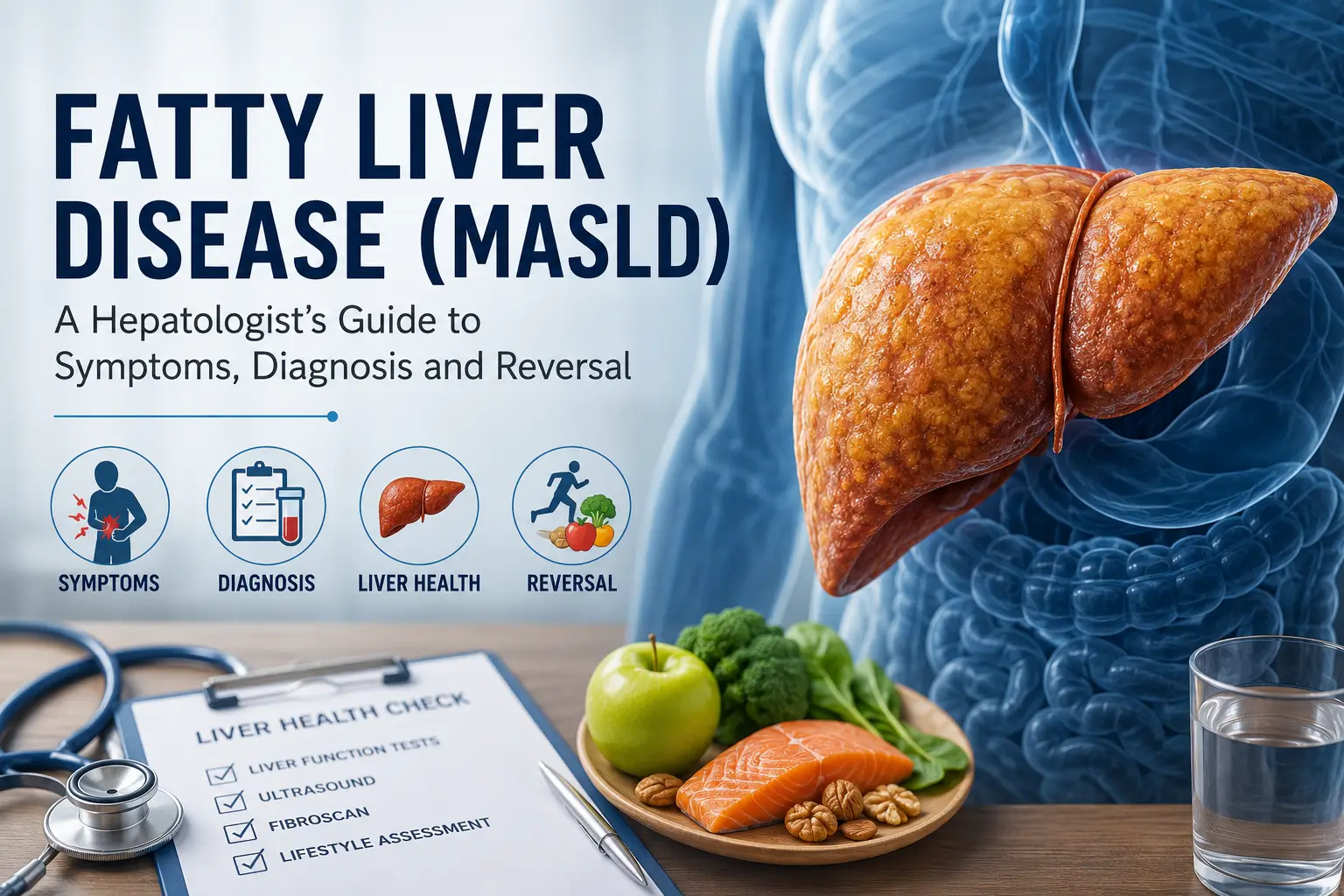
If your GP has told you that you have fatty liver, or you’ve come across the term whilst researching abnormal liver test results, you’re not alone. Fatty liver disease is now the most common liver condition in the UK — and across the wider Western world. What surprises most patients is just how silently it develops, and how reversible it is when caught early.
This guide explains what fatty liver disease actually is, why the medical community has recently renamed it from NAFLD to MASLD, what symptoms to watch out for, and most importantly, what you can do about it. It’s written from clinical experience — what we see in patients every week at our Harley Street clinic — rather than as a generic overview.
Fatty liver disease is exactly what it sounds like excess fat building up inside the cells of your liver. A healthy liver contains very little fat. When more than around 5% of its weight comes from fat, doctors describe it as steatosis, the medical term for fat accumulation.
Until recently, this condition was called non-alcoholic fatty liver disease, or NAFLD. In 2023, the international hepatology community renamed it metabolic dysfunction-associated steatotic liver disease MASLD for short. The reason for the name change matters: NAFLD defined the disease by what it wasn’t (it wasn’t caused by alcohol), whereas MASLD defines it by what it actually is a condition driven by metabolic factors like insulin resistance, raised cholesterol, blood pressure problems, and central obesity.
In practical terms, MASLD and NAFLD describe the same condition. If your previous test results or correspondence mention NAFLD, that’s the same condition we now call MASLD.
MASLD does not mean alcohol is irrelevant. Many people have both metabolic risk factors — such as being overweight, diabetes, cholesterol or blood pressure problems — and high levels of alcohol intake that adds extra strain on the liver. The term MetALD, or metabolic and alcohol-associated liver disease, is used for this overlap: fatty liver linked to metabolic risk factors, with alcohol also contributing to liver injury.
In practical terms, this matters because alcohol and metabolic risk can act together. Even when alcohol is not the only or main cause, regularly drinking above low-risk levels can make fatty liver more likely to progress to inflammation, fibrosis and scarring. Reviewing alcohol intake — and cutting down where needed — is therefore a key part of managing fatty liver disease, alongside weight loss, diet, exercise and treating diabetes, cholesterol and blood pressure.
High levels of regular alcohol consumption, particularly over a longer period of time, can also directly lead to fatty change in the liver, even in the absence of risk factors for MASLD like obesity or diabetes. In this case, it is more helpful to consider the problem in the liver as alcohol-related liver disease and the main action required is to reduce levels of alcohol intake to within lower safe limits.
Fatty liver disease affects an estimated one in three adults in the UK. Among people with type 2 diabetes, the figure rises to more than two in three. Most people with the condition have no idea they have it — and that’s the central challenge with this disease.
It’s also worth being honest about who’s at higher risk. The strongest associations are:
Importantly, you can have fatty liver disease at a normal body weight. We sometimes call this ‘lean MASLD’. It’s less common but very real, and just as important to take seriously.
Here’s the truth that often surprises patients: in the early and middle stages, fatty liver disease usually causes no symptoms at all. The liver is a remarkably forgiving organ. It carries on functioning long after damage has begun.
When symptoms do appear, they tend to be vague and easy to dismiss:
Because these symptoms are so non-specific, fatty liver is almost always diagnosed in one of two ways: incidentally, when blood tests reveal raised liver markers for another reason, or deliberately, when someone with risk factors is screened. This is why we encourage people with diabetes, obesity, or metabolic syndrome to have their liver assessed even when they feel completely well.
If you’ve already had blood tests showing abnormal liver enzymes, our guide to investigating abnormal liver function tests explains what those results mean and what the next steps usually involve.
Standard blood tests ALT, AST, ALP, GGT and bilirubin give the first clue. In fatty liver disease, ALT or GGT is often raised, sometimes mildly and persistently. These tests are useful for flagging a problem but cannot tell us what it is or how advanced the disease is.
A FibroScan is the gold standard for non-invasive assessment of fatty liver disease in the UK. It’s a 15-minute outpatient test that uses ultrasound-based technology to measure two things at the same time: liver stiffness (a marker of scarring or fibrosis), and liver fat content (the CAP score). At our Harley Street clinic, every private FibroScan is performed and interpreted on the same day by a consultant hepatologist so you leave understanding exactly where you stand.
Depending on your FibroScan result and clinical picture, your hepatologist may recommend additional blood-based fibrosis markers (such as the FIB-4 score or the ELF test), abdominal ultrasound, or in a small number of cases, a liver biopsy. In modern practice, biopsy is reserved for the minority of patients where the diagnosis remains unclear or where other liver conditions are suspected.
Our companion guide on FibroScan versus liver biopsy explains in detail when each test is appropriate.
Understanding which stage you’re at is everything in MASLD. Most patients we see have either Stage 1 or Stage 2, both of which are largely reversible with the right care. A smaller number progress to fibrosis or cirrhosis, where management changes substantially.
Stage | What’s Happening | Reversible? |
1. Simple Fatty Liver (Steatosis) | Fat accumulates in liver cells. No inflammation yet. | Yes — fully reversible with lifestyle change in most cases. |
2. MASH (Inflammation) | Fat plus active inflammation and liver cell injury. | Largely reversible if caught and treated. Specialist input needed. |
3. Fibrosis | Scar tissue beginning to replace healthy liver tissue. | Partly reversible. Progression can be halted with the right treatment. |
4. Cirrhosis | Extensive scarring. Liver function impaired. | Not reversible, but progression can be slowed. Requires ongoing specialist care. |
The crucial point is this: most people who develop fatty liver never progress beyond Stage 1 or 2. The risk of progression is driven less by the fat itself and more by the underlying metabolic conditions — type 2 diabetes, obesity, and raised cholesterol. Treating those conditions is what changes the long-term outlook.
For most patients with Stages 1 and 2, the honest answer is yes — fatty liver disease is one of the most reversible chronic conditions in modern medicine. But it requires more than a token effort, and it usually doesn’t reverse from medication alone.
The single most effective intervention is weight loss. Research consistently shows that a 5% reduction in body weight typically improves liver fat content. A 10% reduction often reverses inflammation (MASH) and improves early fibrosis. This isn’t a crash-diet outcome — it’s a sustained, modest change that builds momentum over six to twelve months.
There’s no single ‘liver diet’, but several approaches have strong evidence behind them:
Exercise improves fatty liver disease independent of weight loss. Even if your weight doesn’t change, regular physical activity reduces liver fat through improvements in insulin sensitivity. Current guidance suggests 150 to 200 minutes of moderate activity per week, plus resistance training twice weekly.
If you have type 2 diabetes, PCOS, raised cholesterol, or sleep apnoea, treating those conditions effectively is part of treating your liver. Newer medications used in diabetes (such as GLP-1 receptor agonists) often improve liver health as a side benefit. A specialist hepatologist will look at your whole metabolic picture, not just your liver.
It’s worth seeing a hepatologist if any of the following apply to you:
At Leaders in Liver Health, our consultants provide rapid assessment and personalised management plans for fatty liver disease. You can book a specialist fatty liver consultation at our Harley Street clinic, with same-week appointments usually available.
At Stages 1 and 2, fatty liver disease is highly treatable and usually carries little long-term risk if managed well. It becomes more serious as it progresses through inflammation and fibrosis to cirrhosis, but this progression takes years and usually only occurs when the underlying drivers — diabetes, obesity, metabolic syndrome — are not addressed. The honest answer is that it’s a condition to take seriously, not to panic about.
Yes — and this is the most common form. The renaming from NAFLD to MASLD reflects that the metabolic drivers (insulin resistance, central obesity, raised cholesterol) cause the condition independently of alcohol. Many of our fatty liver patients don’t drink at all.
Most patients see liver enzyme improvements within four to twelve weeks of meaningful lifestyle change. CAP score (liver fat content on FibroScan) typically reduces over three to six months. Fibrosis, where present, takes longer to improve.
Most patients with early MASLD don’t need liver-specific medication. The treatment is lifestyle and management of underlying conditions. In selected cases — particularly with active inflammation (MASH) or advanced fibrosis — medication may be appropriate. New treatments specifically for MASH have recently been approved and are reshaping options for patients with more advanced disease.
Fatty liver describes fat accumulation in liver cells. Cirrhosis is the end stage of chronic liver damage, where extensive scarring has replaced healthy tissue. Fatty liver can progress to cirrhosis over many years if left untreated, but the vast majority of people with fatty liver never reach this stage. Many other causes of chronic liver injury can also lead to cirrhosis.
Yes — and the evidence is genuinely strong. Multiple large studies have shown that two to three cups of black coffee per day is associated with lower rates of liver fibrosis and reduced progression of fatty liver disease. The protective effect appears to come from coffee’s polyphenols and is independent of caffeine. Cream and sugar negate the benefit.
Yes, and unfortunately it’s becoming more common. Paediatric fatty liver disease is driven by the same metabolic factors as in adults. If your child has been diagnosed, specialist input is important.
The most important thing to take away is this: fatty liver disease is common, usually silent, and largely reversible when caught early. The combination of a non-invasive FibroScan, blood tests, and personalised input from a hepatologist gives you a clear picture of where you stand — and a realistic plan to improve it.
If you’d like a comprehensive assessment of your liver health, you can book a consultation with our fatty liver specialists in London at our Harley Street clinic. Same-week appointments are usually available. Call 020 4621 0765 to discuss your case.
European Association for the Study of the Liver (EASL). EASL-EASD-EASO Clinical Practice Guidelines on the management of metabolic dysfunction-associated steatotic liver disease (MASLD). Journal of Hepatology, 2024.
National Institute for Health and Care Excellence (NICE). Non-alcoholic fatty liver disease (NAFLD): assessment and management. NG49.
Rinella ME et al. A multisociety Delphi consensus statement on new fatty liver disease nomenclature. Hepatology. 2023;78(6):1966-1986.
British Society of Gastroenterology (BSG). Guidelines on the management of abnormal liver blood tests.
British Liver Trust. Non-alcoholic fatty liver disease (NAFLD/MASLD) — patient information.
This article was reviewed by [Consultant Name], Consultant Hepatologist at Leaders in Liver Health (GMC: XXXXXXX). [Brief 2-line bio mentioning hospital affiliations, areas of expertise, and years of experience]. Read more on our team page.
Prevention is the best medicine, but knowing where to start can be challenging. Our liver specialists provide evidence-based prevention advice tailored to your individual circumstances.
Take control of your liver health with expert guidance.
WhatsApp us
Fill out the form below to schedule a consultation with our liver health specialists. Our team will review your information and contact you within 24 hours to arrange an in-person or virtual consultation. This helps us understand your concerns and offer the best personalized care for your liver health.