
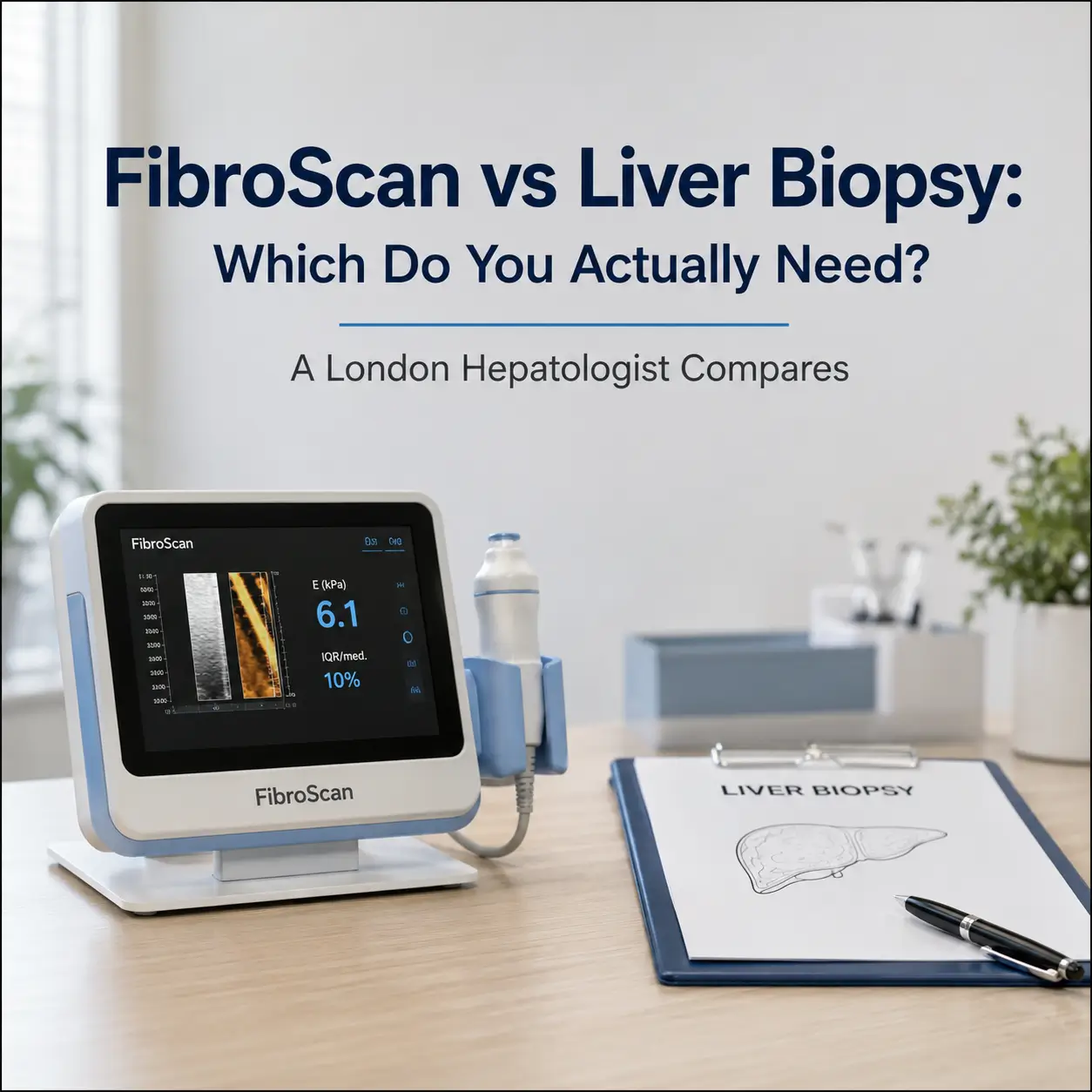
If your GP or specialist has mentioned a liver biopsy or you’ve researched one yourself you may be wondering whether there is a less invasive option. For the majority of patients, the answer is yes.
FibroScan has transformed how we assess liver disease over the past 15 years. For the majority of patients who would previously have needed a biopsy, FibroScan now provides equivalent clinical information without a needle, without anaesthetic, and without hospital admission. But this is important biopsy still has a clear place in liver medicine for some patients.
This guide compares the two tests: when FibroScan is the right choice, when biopsy is genuinely needed, and how to decide? If you’re considering your options, a private FibroScan in London with a consultant hepatologist is usually the appropriate first step your specialist will then advise if biopsy adds anything more.
For most patients with suspected fatty liver disease (MASLD), viral hepatitis, or alcohol-related liver disease, FibroScan is now the recommended first-line test. It is non-invasive, immediate and repeatable. Liver biopsy remains essential when the diagnosis is unclear, when rare or autoimmune conditions are suspected, or when FibroScan results are inconclusive or contradictory.
Factor | FibroScan | Liver Biopsy |
Duration | 10–15 minutes | 4–6 hours (including recovery) |
Invasiveness | Non-invasive (external probe) | Invasive (needle into liver) |
Pain or discomfort | None — like an ultrasound | Moderate after procedure |
Accuracy for fibrosis | High | Gold standard |
Recovery time | Immediate — back to normal | 24+ hours bed rest needed |
Serious complications | None | ~1 in 1,000 (bleeding, perforation, infection) |
Cost (UK private) | £350–£500 | Over £2,000 |
Repeatable | Yes — annually or more often | Rarely — only when essential |
Time to results | Same day with consultant | Up to 14 days for pathology |
FibroScan is the right first-line test in these situations:
The most common liver condition in the UK. FibroScan provides both fibrosis staging (kPa) and fat quantification (CAP score) in a single 15-minute test information no biopsy could give you faster. Repeat scans every 12 months track whether your lifestyle changes are working.
EASL and NICE guidelines now recommend FibroScan as the routine monitoring tool for hepatitis B and C. It allows regular surveillance something biopsy simply cannot offer due to its invasive nature.
FibroScan is ideal for staging fibrosis in alcohol-related liver disease and tracking improvement after reducing or stopping alcohol intake. Repeat scans are key to seeing whether the liver is recovering.
If you’ve been told you have raised liver enzymes, an abnormal liver scan, or a suspected liver condition FibroScan should generally be your first specialist test. It rapidly identifies whether you are at low, moderate, or high risk, and that guides everything that comes next.
Methotrexate, amiodarone, and certain other medications require periodic liver assessment. FibroScan replaces the previous practice of routine biopsy for these patients
FibroScan does not replace biopsy in every situation. Biopsy remains the gold standard and the right choice when the questions a specialist needs answered cannot be addressed by a non-invasive scan.
Conditions like autoimmune hepatitis often require histological confirmation. Pattern of cell damage, inflammation type, and tissue architecture matter and only a biopsy shows these in detail.
Sometimes FibroScan gives borderline numbers, technically poor readings, or results that don’t match the clinical picture. Biopsy can resolve the uncertainty.
FibroScan measures stiffness, not inflammation. If your specialist needs to know the degree of active inflammation not just scarring, biopsy provides information that FibroScan cannot.
If imaging has identified a focal lesion (mass or nodule) and the nature is unclear after MRI or CT, a targeted biopsy of that lesion is often required.
In some cases of medication-related liver injury, biopsy is needed to confirm the diagnosis and rule out other causes, particularly when stopping the medication does not improve liver enzymes.
Pre-transplant evaluation often requires biopsy to fully characterise the underlying disease.
The right way to decide is rarely “FibroScan or biopsy?” in isolation. It’s “What is the clinical question, and which test best answers it?” That’s the value of a consultant hepatology consultation — your specialist reviews your full history, blood results, and imaging together, then recommends the test (or combination of tests) that gives the most useful information for your case.
The most up-to-date hepatology practice doesn’t rely on a single test. It combines:
This combination is what allows modern hepatology to make accurate diagnoses non-invasively in most patients. Biopsy is reserved for genuine clinical need — not as a default first step.
For fibrosis staging in common chronic liver diseases (fatty liver, viral hepatitis, alcohol-related disease), FibroScan is considered accurate and is now accepted as equivalent in clinical guidelines from EASL, AASLD, and NICE. Biopsy remains slightly more accurate for inflammation grading and specific diagnoses, which is why it still has a role.
Yes, absolutely — and it’s often a good idea. Biopsy gives a one-time snapshot. FibroScan can be repeated annually to track progression or improvement. Many patients use biopsy for diagnosis and FibroScan for ongoing monitoring.
Usually because they need information FibroScan cannot provide — typically the degree of inflammation, the pattern of cell damage, or confirmation of a specific diagnosis (such as autoimmune hepatitis). The recommendation is clinically driven, not preference-based. A second opinion from a hepatologist can clarify whether biopsy is genuinely needed in your case.
This is a question to discuss carefully with your specialist. In some cases, FibroScan plus blood-based fibrosis markers gives enough information to manage your condition without a biopsy. In other cases, declining a biopsy could mean a delayed or missed diagnosis. The answer depends entirely on what your specialist is trying to find out.
Very few. For example, severe ascites (fluid in the abdomen) can make FibroScan unreliable or impossible. For most patients with high BMI, the XL probe overcomes the limitations of the standard M probe. Your specialist will check suitability before the scan.
Yes, but availability and waiting times vary significantly by region and condition. Private FibroScan eliminates the wait and ensures the scan is performed and interpreted by a consultant hepatologist on the day — not weeks later in a separate appointment.
The choice between FibroScan and biopsy is rarely a binary decision — it’s part of a wider clinical picture that includes your symptoms, blood results, imaging, and medical history. The fastest way to clarity is a focused consultation with a hepatologist who reviews everything together and recommends the right approach for your case.
At Leaders in Liver Health, you can book a private FibroScan with a consultant hepatologist who will explain the result on the day and discuss whether anything further is needed. Same-week appointments are available at our Harley Street clinic. Call us on 020 4621 0765 to arrange your consultation.
European Association for the Study of the Liver (EASL). Clinical Practice Guidelines on non-invasive tests for evaluation of liver disease severity and prognosis. Journal of Hepatology, 2021.
National Institute for Health and Care Excellence (NICE). Non-alcoholic fatty liver disease (NAFLD): assessment and management. NG49.
Castera, L., Friedrich-Rust, M., Loomba, R. Noninvasive Assessment of Liver Disease in Patients With Nonalcoholic Fatty Liver Disease. Gastroenterology, 2019;156(5):1264–1281.
British Society of Gastroenterology (BSG). Guidelines on the management of abnormal liver blood tests.
British Liver Trust. Liver biopsy and FibroScan – patient information.
This article was reviewed by Apostolos Koffas, Consultant Hepatologist at Leaders in Liver Health (GMC: 7360520). [Brief 2-line bio mentioning hospital affiliations, areas of expertise, and years of experience]. Read more on our team page.
Prevention is the best medicine, but knowing where to start can be challenging. Our liver specialists provide evidence-based prevention advice tailored to your individual circumstances.
Take control of your liver health with expert guidance.
WhatsApp us
Fill out the form below to schedule a consultation with our liver health specialists. Our team will review your information and contact you within 24 hours to arrange an in-person or virtual consultation. This helps us understand your concerns and offer the best personalized care for your liver health.